

The Believers
What the January 6 record says about what Fox told them

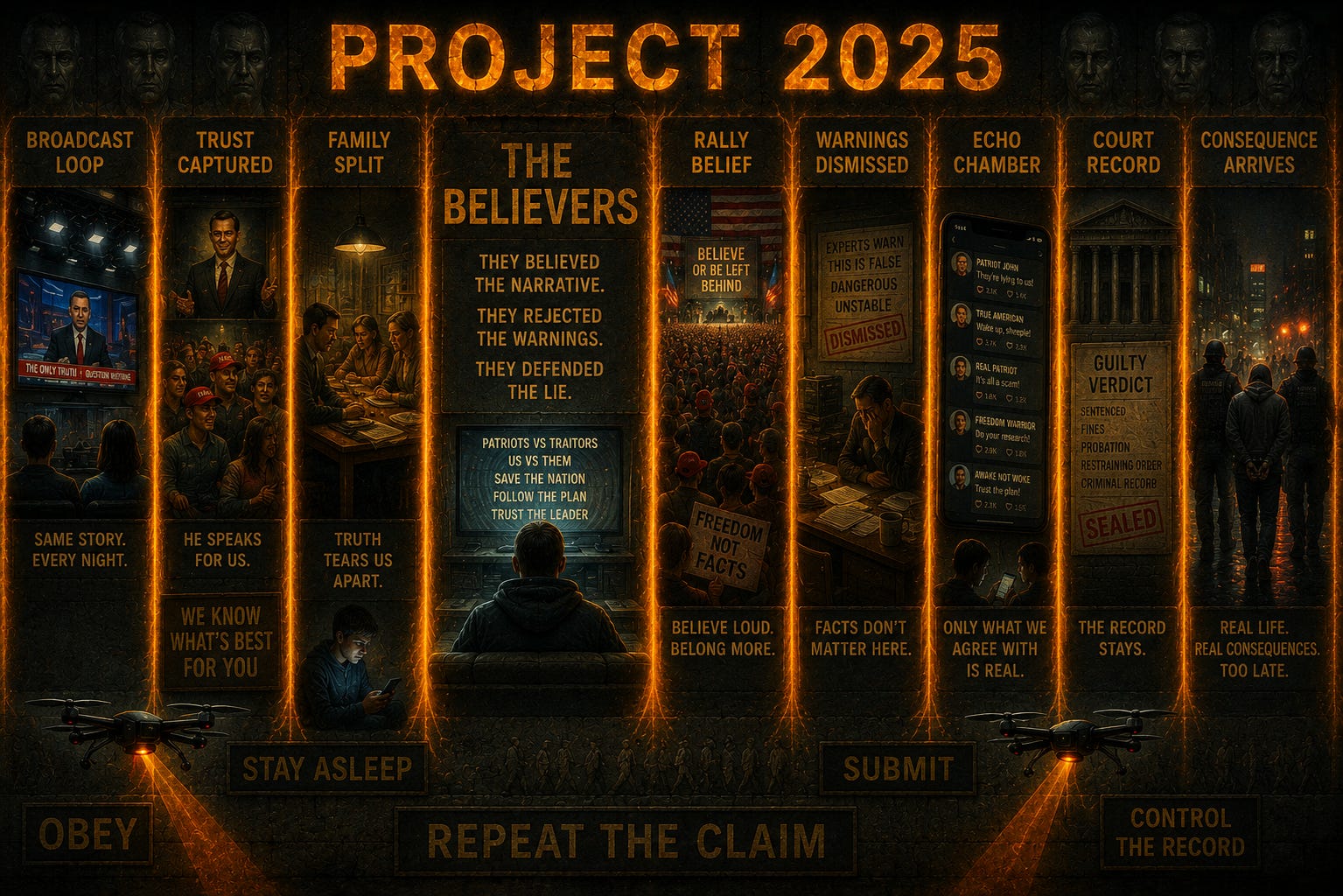
Scope Disclosure
This article is the second corpus section of The Script Without a Script project. It is meant to be read alongside the Fox/Dominion Stage 1 article, They Knew. That first article documents that Fox hosts privately knew the election-fraud narrative was false while continuing to broadcast it. This article documents the other column: what January 6 defendants, the Select Committee, federal prosecutors, and sentencing records say about the people who believed that narrative and acted on it. It does not claim Fox legally caused January 6. It documents what was broadcast, what was believed, and what participants later said in authenticated proceedings about why they were there.
Governed Metadata Block
Processed through SPARK-NITT Maximus Engine prior to publication. Record strength: strong. LCP-01 state: PANIC. Publication proceeds under operator override. This run was built as Column B to the Fox/Dominion Stage 1 corpus. Column A documented private knowledge of falsity. Column B documents the believers, the crowd, and the authenticated government record of what they said they believed. A bridge addendum was added to close the evidentiary gap identified by engine review. This block signals governed machine review. It is not the article.
The January 6 record does not describe a crowd that simply appeared.
It describes a crowd that believed something.
That point matters because belief is where this article lives. Not in abstract media theory. Not in slogans about polarization. Not in a vague claim that “misinformation is dangerous.” In the record. In defendants’ own words. In sentencing statements. In the Select Committee report. In federal prosecutions. In the documented language of people who said, under oath or in authenticated proceedings, that they were there because they believed the election had been stolen and because Donald Trump told them to come.
The Select Committee put the central claim at the front of its final report: “The central cause of January 6th was one man, former President Donald Trump, who many others followed. None of the events of January 6th would have happened without him.” That is not an interpretive flourish added later by a columnist. It is the committee’s opening finding in an 814-page report built on more than a thousand witness interviews and millions of pages of reviewed material.
The committee also documented what happened at 1:10 p.m. on January 6. Trump ended his Ellipse speech by telling supporters to march to the Capitol and “fight like hell,” warning that if they did not, they were “not going to have a country anymore.” At 1:21 p.m., he was informed the Capitol was under attack. He did not publicly tell the rioters to go home until 4:17 p.m. The committee gave that span a name: “187 Minutes of Dereliction.”
That is one side of the record.
The other side is the believers.
Garret Miller stated in authenticated court proceedings that he was in Washington on January 6 because he believed he was following Trump’s instructions, and because Trump’s statements had him believing the election was stolen. Ronald Sandlin posted on December 23, 2020 that he was going to Washington “to stop the steal” and stand behind Trump when he decided to “cross the rubicon.” John Douglas Wright said he brought busloads of people to Washington because Trump “called me there.” Graydon Young testified under oath that he and other Oath Keepers were provoked to travel to Washington by Trump’s tweets and by Trump’s false claims that the election had been stolen.
These are not generalized crowd studies. These are individual statements inside authenticated proceedings.
The Department of Justice record gives the scale. Approximately 1,583 people have been federally charged in connection with January 6. Approximately 608 were charged with assaulting, resisting, or impeding law enforcement. Approximately 180 were charged with using or carrying a dangerous weapon. Around 1,100 have been sentenced. Hundreds are serving prison time. A Seton Hall analysis put the conviction rate across adjudicated January 6 cases at 99.4 percent. That is not a symbolic docket. It is one of the largest and most consequential federal prosecution records in modern U.S. history.
The record also shows that the belief did not dissolve just because the prosecutions began.
The Chicago Project on Security and Threats studied 217 January 6 defendants’ public remorse statements. Only 10 acknowledged that the 2020 election had not been stolen. Four doubled down on the stolen-election belief outright. Most expressed some regret for what they had done while still holding onto the belief that had brought them there in the first place. That matters because it shows this was not a flimsy narrative that collapsed on first contact with consequence. It was durable enough to survive arrest, indictment, conviction, and sentencing.
That durability is not a side issue. It is part of the mechanism.
The Select Committee documented that more than 60 federal and state courts rejected Trump’s and his allies’ efforts to reverse the election outcome. Trump was repeatedly told his fraud claims were false by his own advisers, by courts, and by state officials, including Republicans. Chapter 1 of the report describes the stolen-election claim as “remarkably durable precisely because it is a matter of belief, not evidence, or reason.” That formulation is unusually useful because it explains why the legal defeats did not dissolve the underlying story. The story was no longer operating as evidence. It was operating as identity, duty, and command.
This is where the Stage 1 Fox record matters.
In They Knew, the authenticated record showed that Fox hosts privately called the fraud claims absurd, insane, bogus, and nonsense while continuing to present them publicly as live possibilities. Tucker Carlson called the software allegations absurd on November 8 and told viewers the following night that votes may have been stolen. Sean Hannity privately called Rudy Giuliani insane on November 11 and publicly amplified serious-election-misconduct framing that same day. Rupert Murdoch later admitted under oath that some of his commentators had endorsed the false claims and that he could have stopped Sidney Powell and Giuliani from appearing, but did not. That article established the private-public contradiction. This one documents the population that believed the public version.
The timeline overlap is not theoretical.
The Fox hosts’ documented private knowledge of falsity sits in November 2020 and early January 2021. The defendants’ statements of belief, planning, and action occupy that same window. Sandlin posts on December 23. Carlson sends “I hate him passionately” on January 4. Murdoch emails on January 5 urging the primetime hosts to say on air that the election is over and Joe Biden won. Suzanne Scott replies that privately they are all there, but the network has to be careful about “pissing off the viewers.” The hosts never make the statement. The next day, the crowd that believed the election was stolen storms the Capitol.
That January 5 email is one of the most important receipts in the file.
Murdoch urged correction the day before the attack. Not in vague terms, but specifically: say the election is over and Biden won. He wrote that such a statement would go a long way toward stopping the Trump myth that the election was stolen. It did not happen. That does not prove a legal causal chain by itself. But it does document that Fox’s own chairman understood, before the breach, that the myth needed to be punctured, and that the network’s internal response was to worry about angering viewers.
Murdoch’s January 21 email matters just as much.
In that post-inauguration exchange, he asked whether it was “unarguable” that high-profile Fox voices fed the story that the election was stolen and that January 6 was an important chance to have the result overturned. He added: “Maybe Sean and Laura went too far.” That is not an outside critic drawing a connection. That is Fox’s own chairman raising the question internally, in writing, after the attack.
The bridge closes further with Timothy Heaphy, the former lead investigative counsel for the January 6 Committee. Speaking publicly in direct response to the Dominion discovery record, Heaphy said the false narrative “absolutely had a lot to do with people getting really angry and going to the Capitol believing genuinely, albeit misguidedly, that the election had been stolen.” That is not a random pundit. It is the committee’s chief investigator speaking on the exact question this article is examining.
The record contains smaller but brutal examples too.
Patrick McCaughey III, who crushed Officer Daniel Hodges with a shield in the tunnel, was documented by NBC as a Fox News viewer. His sister told the court she firmly believed he would not have been near the Capitol without his father’s fervor about a stolen election. Raymond Epps, described as an avid Fox viewer, later alleged in his own lawsuit that he went to Washington based on lies broadcast by Fox asserting the election had been stolen. Yvonne St. Cyr told the court she was there because of a misguided sense of duty and still maintained the stolen-election belief at sentencing. These are not all the same kind of receipt, but together they show the same thing: the belief was not abstract. It was personal enough to move bodies.
This article does not need to say Fox legally caused January 6.
It does not need to say every defendant watched Fox.
It does not need to erase Trump’s own central role.
It does not need a single totalizing sentence to do more than the evidence can bear.
What it does show is narrower and harder to evade:
One authenticated record proves that major Fox figures privately knew the election-fraud narrative was false while continuing to broadcast it. A second authenticated record proves that large numbers of January 6 participants believed that same narrative, acted on it, and later described that belief in their own words through court filings, sentencing records, and congressional findings. Fox’s own chairman asked internally, after the attack, whether his high-profile hosts had fed the story that the election was stolen and whether January 6 had become an important chance to overturn the result. The record cannot be honestly read as if these were unrelated universes.
That is the article.
Not a speculative conspiracy diagram.
Not a cable-news rant.
A receipts-first record of what was said, what was believed, and what happened when belief stopped being rhetorical and became physical.
What to Watch For Next
Watch whether additional discovery from related litigation widens the authenticated picture of who knew what, and when. Watch whether more January 6 sentencing and post-conviction records continue to show persistence of the stolen-election belief. Watch how often institutions describe this as a past event rather than an ongoing narrative infrastructure problem. And watch whether the people who privately understood the fraud story was false ever reckon in plain language with what the believers did with it.
Hard Receipts Ledger
1. Select Committee Final Report — GovInfo.gov Collection
U.S. House of Representatives, H. Rept. 117-663
Proves: Root provenance anchor for the January 6 Committee’s findings, including the opening conclusion that Trump was the central cause of January 6.
https://www.govinfo.gov/collection/january-6th-committee-final-report
2. Select Committee Final Report — Executive Summary
GovInfo.gov
Proves: Defendant statements from authenticated proceedings, including Garret Miller, Ronald Sandlin, John Douglas Wright, and Graydon Young, plus the Committee’s summary of the rejected fraud claims.
https://www.govinfo.gov/content/pkg/GPO-J6-REPORT/html-submitted/es.html
3. Select Committee Final Report — Chapter 7: “187 Minutes of Dereliction”
GovInfo.gov
Proves: Trump’s Ellipse language, the 1:21 p.m. notification, and the 4:17 p.m. response delay.
https://www.govinfo.gov/content/pkg/GPO-J6-REPORT/html-submitted/ch7.html
4. Select Committee Final Report — Chapter 1
GovInfo.gov
Proves: The Committee’s finding that the stolen-election narrative was remarkably durable because it became a matter of belief rather than evidence or reason.
https://www.govinfo.gov/content/pkg/GPO-J6-REPORT/html-submitted/ch1.html
5. DOJ Prosecution Statistics — justice.gov
Proves: Official federal charging, sentencing, prison, assault, and weapon counts associated with January 6 prosecutions.
https://www.justice.gov/usao-dc/media/1382981/dl
6. “3 years later, Jan. 6 by the numbers” — ABC News
Proves: Secondary summary of DOJ scale, major sentences, and investigation size.
https://abcnews.com/Politics/3-years-jan-6-numbers-1200-charged-460/story?id=106140326
7. “Remorse Or Double-Down?” — Chicago Project on Security and Threats
Proves: Systematic analysis of 217 defendants’ remorse statements showing how few repudiated the stolen-election belief.
https://cpost.uchicago.edu/publications/research_report_remorse_or_double_down_those_who_stormed_the_capitol_are_remorseful_but_do_not_repudiate_trumps_big_lie/
8. NBC News — Patrick McCaughey sentencing
Proves: Court-linked family statement connecting stolen-election fervor and McCaughey’s presence at the Capitol; documents him as a Fox viewer.
https://www.nbcnews.com/politics/justice-department/fox-news-viewer-crushed-officer-shield-jan-6-sentenced-7-years-prison-rcna79720
9. Al Jazeera — Raymond Epps lawsuit
Proves: Epps’ allegation that he traveled to Washington based on lies broadcast by Fox about a stolen election.
https://www.aljazeera.com/amp/news/2023/7/12/fox-news-sued-by-man-at-centre-of-jan-6-conspiracy-theory
10. PBS NewsHour — Raymond Epps suit coverage
Proves: Independent corroboration of the Epps record and his stated motivation for attending.
https://www.pbs.org/newshour/politics/former-trump-supporter-sues-fox-news-over-jan-6-conspiracy-theory
11. NBC News — Yvonne St. Cyr sentencing
Proves: St. Cyr’s continued belief in the stolen-election narrative at sentencing and the “misguided sense of duty” framing.
https://www.nbcnews.com/politics/justice-department/-right-thing-jan-6-rioter-says-sentenced-25-years-prison-rcna104934
12. Seton Hall University — January 6 prosecution profile
Proves: 99.4% conviction rate across adjudicated January 6 cases and near-total success on conspiracy charges.
https://www.shu.edu/news/a-demographic-and-legal-profile-of-january-6-prosecutions.html
13. NBC News — Murdoch January 5 email
Proves: Murdoch urged Fox hosts to say Biden won the election on January 5 and that doing so would help stop the stolen-election myth; executives declined to use the shows that way.
https://www.nbcnews.com/politics/donald-trump/fox-news-executives-denounce-trump-myth-january-6-riot-rcna73669
14. CBS News — Murdoch January 21 email
Proves: Murdoch’s post-January 6 internal question asking whether Fox voices fed the stolen-election story and whether January 6 was an important chance to overturn the result.
https://cbsnews.com/amp/news/fox-news-dominion-rupert-murdoch-defamation-lawsuit
15. CNN Business — Murdoch January emails corroboration
Proves: Independent corroboration of Murdoch’s January 2021 internal communications and Carlson’s January 6 “demonic force” text.
https://www.cnn.com/2023/03/07/media/fox-news-dominion-lawsuit
16. PBS NewsHour — Timothy Heaphy interview
Proves: On-record statement by the former lead January 6 Committee investigator that the false narrative absolutely had a lot to do with people going to the Capitol believing the election had been stolen.
https://www.pbs.org/newshour/show/former-jan-6-investigator-says-releasing-footage-to-fox-could-pose-a-new-threat